
Free Guide for Parents of Junior Fast Bowlers
Back Pain Is Rarely Growing Pains.
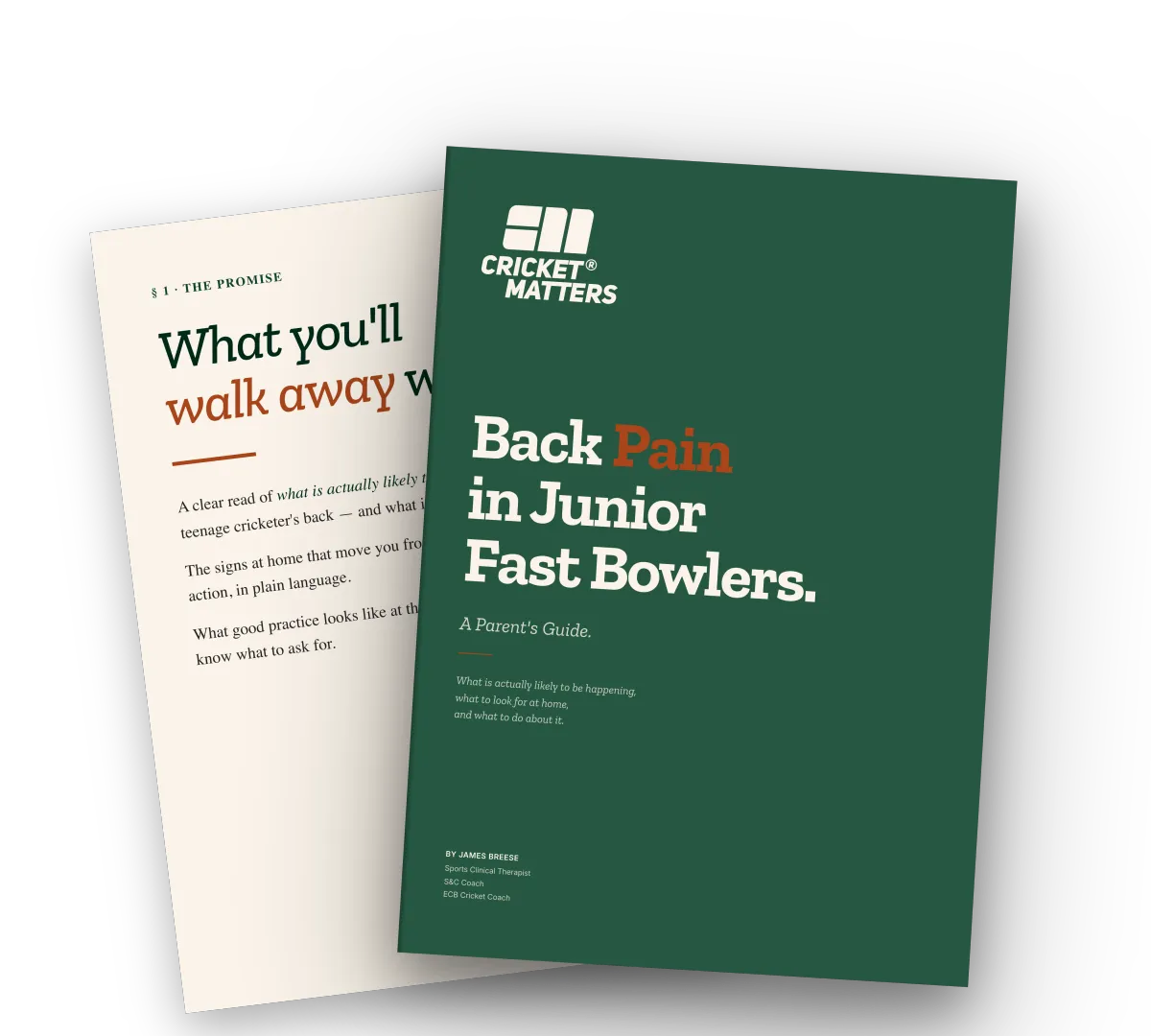
What is actually likely to be happening, what to look for at home, and what to do about it.
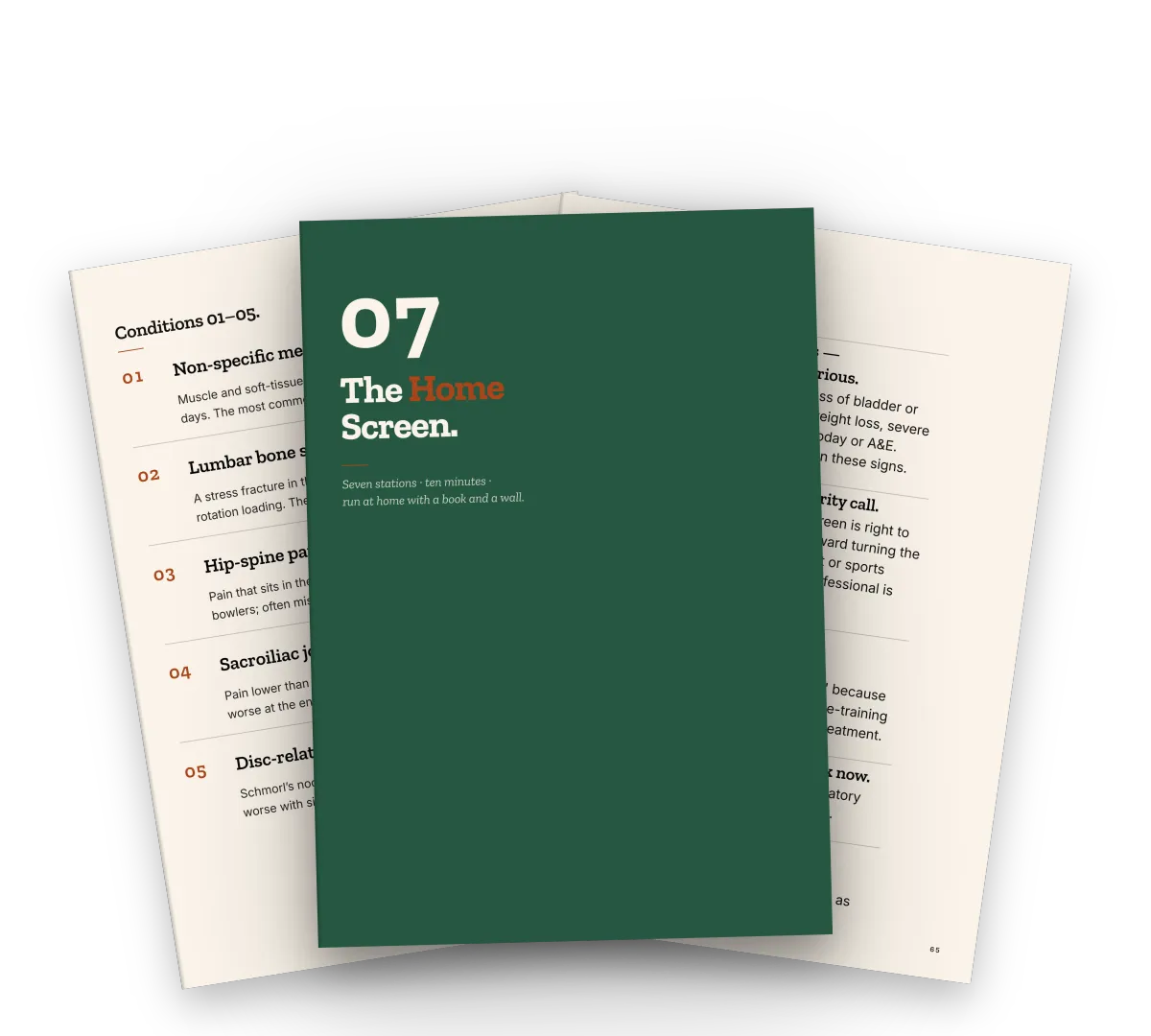
Inside the Guide
What is actually likely to be happening — the eleven conditions cricket produces in a teenage spine.
What to look for at home — a seven-station screen, ten to fifteen minutes, a book and a wall.
What to do based on what you find — routing for every result, including a free clarity call if the screen surfaces a question.
Four Diagnostic Moments.
01
A Diagnostic Move You Can Run Now
The squat cascade — a single test that produces four different answers, each pointing somewhere specific in the body.
02
Eleven Conditions Behind the Pain
The differential cricket actually produces in a teenage back — none of them growing pains, all of them worth knowing about.
03
The Home Screen — Seven Stations
Ten to fifteen minutes at home with a book and a wall. The cricketer performs; you observe.
04
What to Do Based on the Results
Four routing pathways from the screen, including a free 20-minute clarity call when the screen surfaces a question.
Why We Wrote This
The Work This Came From.
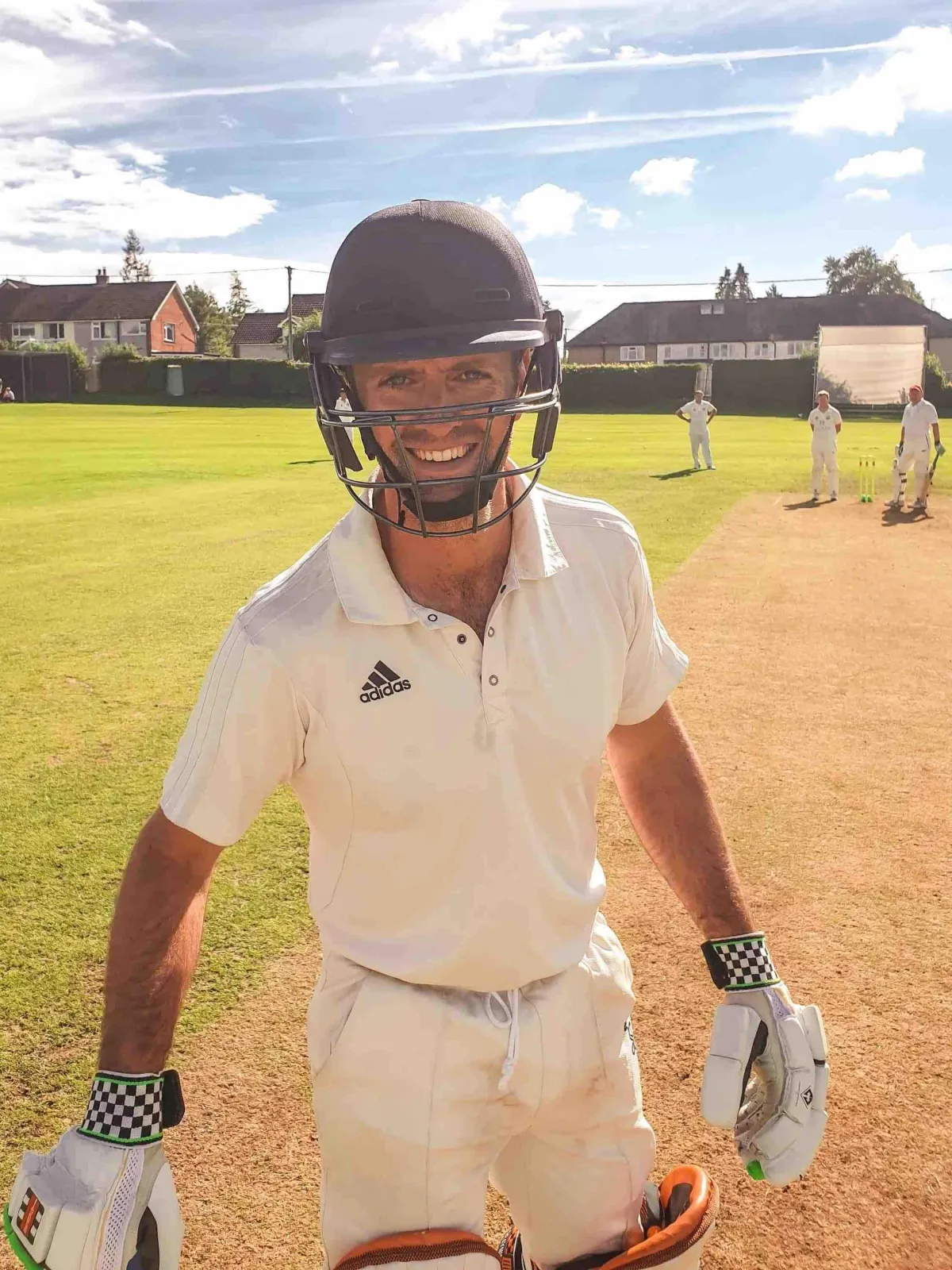
Cricket Matters is the work of James Breese — a Sports Clinical Therapist, an S&C Coach, and an ECB Cricket Coach. One person across all three layers, not three specialists holding different pieces.
The integrated picture is what most cricket-and-pain content lacks. The GP looks at the back. The physio looks at the body. The cricket coach looks at the action. Nobody holds the three together.
Cricket Matters does, because the same person holds all three credentials. That is what this guide draws on.
If you want to talk it through after reading, a free 20-minute clarity call with a Cricket Matters Certified Professional is available — no commitment beyond the conversation.
"The back is the part of the body that keeps lending out range it does not own."
FROM THE OPENING OF THE GUIDE
Nine Sections, One Diagnostic Move.
INSIDE THE GUIDE
§ 01
Promise
What this guide does and does not do.
§ 02
A Diagnostic Move You Can Run Now
The squat cascade in three stages.
§ 03
Beyond Growing Pains
The eleven conditions cricket produces.
§ 04
What the Research Actually Says
Engstrom, Keylock, the pattern.
§ 05
A Case from the Clinic
Two years of pain, one assessment.
§ 06
The Workload Nobody Is Counting
Multi-team load nobody coordinates.
§ 07
The Home Screen
Seven stations, ten to fifteen minutes, at home.
§ 08
What to Do Based on the Results
Routing for every screen outcome.
§ 09
What Comes Next
The free 20-minute clarity call with a Cricket Matters Certified Professional.
FAQ.
Is This Medical Advice?
This guide is screening, not diagnosis or medical advice. The home screen produces information about movement patterns and red flags. For specific clinical advice, your GP or the NHS per the routing inside the guide is the right route. A free 20-minute clarity call with a Cricket Matters Certified Professional is available if you want help figuring out what to do with what the screen surfaces.
What Age Range Is This For?
Junior cricketers roughly 11 to 17 years old. The 15-to-17 window carries the highest risk for lumbar bone stress per the published research; the home screen reads the body at any age in that band.
My Child Hasn't Been Diagnosed — Should I Still Read This?
Yes, especially then. The guide is built for the period before diagnosis — when the GP has said growing pains, when the physio has prescribed stretches, when nothing has resolved. The cricket-specific differential is the part most general practice has no reason to know about.
Do I Need to Book a Call to Use the Guide?
No. The guide stands alone. The free 20-minute clarity call with a Cricket Matters Certified Professional is for parents who want a specific routing conversation after running the home screen. We talk through what you have seen at home and figure out together whether an injury assessment is the right next step. No commitment beyond the conversation.
Is the Home Screen Safe to Run With My Child?
Yes. Every movement in the screen is a position the body should be able to find on its own. The screen does not load the cricketer beyond their own body weight. If pain or inability to perform a movement appears at any point, the screen stops and routes per the red-flag list.
What if My Child Is in Pain Right Now?
This guide does not replace medical advice. If your child has numbness or weakness in a leg, loss of bladder or bowel control, fever, unexplained weight loss, severe night pain that wakes them from sleep, or a serious accident is involved, contact a GP today or A&E directly. Out of hours, NHS 111 is the right call when the situation is urgent but not an emergency. The cricket-specific differential in this guide is for everything else.
READ IT TONIGHT
Back Pain Is Rarely Growing Pains.
The guide tells you what it usually is — what to look for at home, and what to do about it. Free. Twenty minutes.
Produced by James Breese, Sports & Clinical Therapist. Founder, Cricket Matters.
Cricket Matters is a trading name of Strength Matters Limited, a private limited company registered in England and Wales (Company No. 09273569). Registered Office: Brynawel, Aberhafesp, Newtown, Powys, SY16 3HL, United Kingdom. VAT No: GB240341943. ICO Registration: ZC073387
©2026 Cricket Matters. All rights reserved.
MADE IN WALES